We look forward to seeing you at the 2025 Chesapeake Regional Ethics Bowl, which will take place on December 6, 2025, at UMBC. Click the links below for more information.
Watch the 2025 Chesapeake Regional Finals
2025 Chesapeake Regional Ethics Bowl Results
The University of Maryland, Baltimore County (UMBC) won the 2025 Chesapeake Regional Ethics Bowl, defeating Washington and Lee in the finals. The third place team was St. Mary’s College of Maryland, and the fourth place team was Salisbury University. The top three teams – UMBC, Washington and Lee, and St. Mary’s – will be competing at the National Ethics Bowl Tournament taking place in St. Louis, MO in March 2026. Many congratulations to those teams, and to all the teams who competed this year.
- University of Maryland, Baltimore County
- Washington and Lee University
- St. Mary’s College of Maryland
- Salisbury University
- Virginia Tech
- University of Baltimore
- Princeton University
- Tufts University
- Villanova University
- West Chester University
- Montgomery College
- Temple University
- Camden County College
- Penn State University
- Virginia Military Institute
- Notre Dame of Maryland University
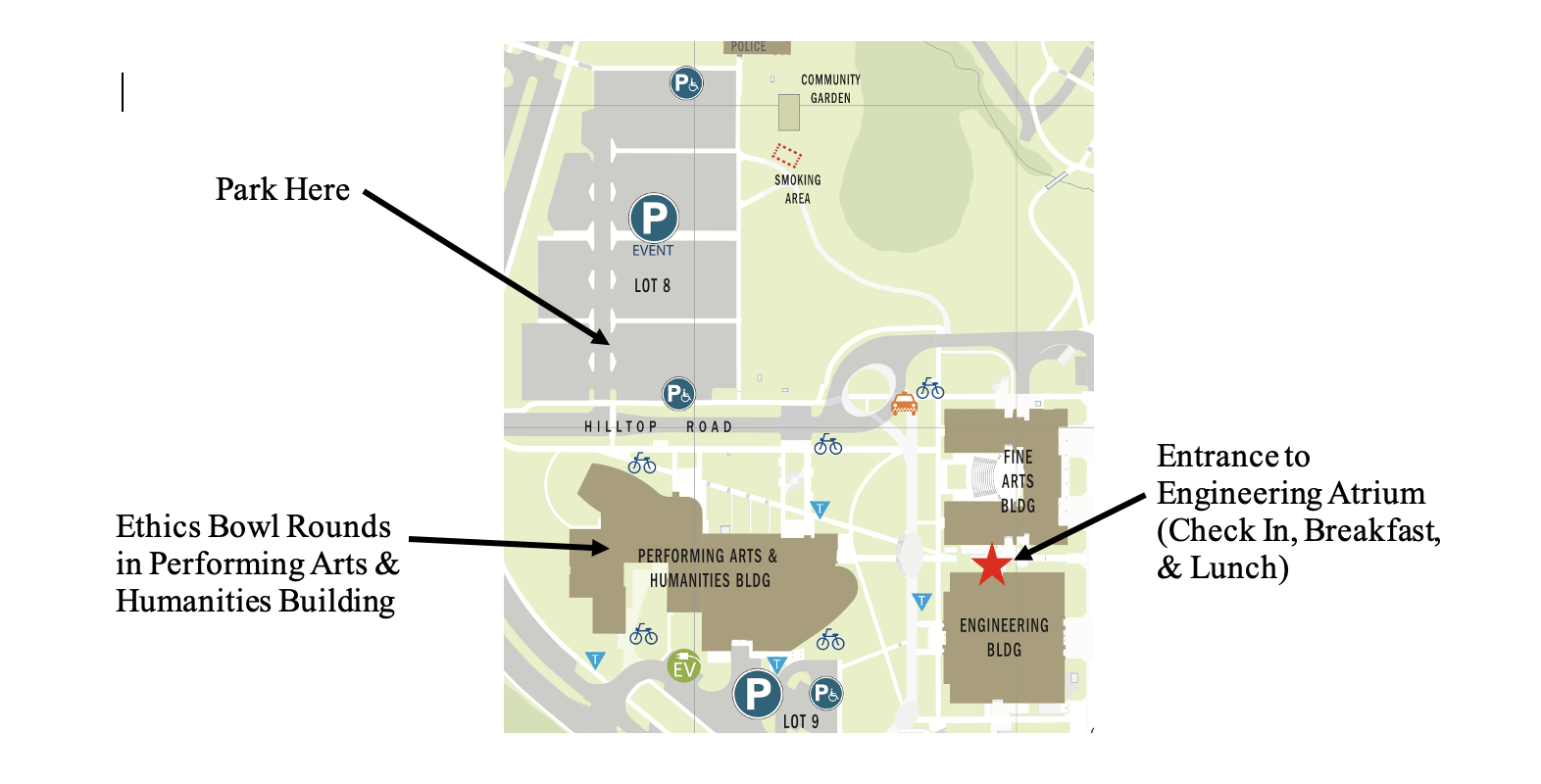
Maps & Directions
We recommend using Google Maps for the most reliable directions. Click the link below for additional instructions on getting here.
Schedule

Information for Officials (Judges and Moderators)
If you would like to volunteer to serve as a judge or moderator, email Professor Greg Ealick at ealick@umbc.edu. No experience is required.
Judge and Moderator Assignments
Information for Officials (Judges and Moderators)
Officials are critical to ethics bowl: the event simply can’t happen without many people volunteering their time. But while officials are very important, no particular skill set is important to making a good official. It is deep in the spirit of ethics bowl that ethics is not the property of philosophers. It belongs to everyone. This means that judges absolutely do not need any special knowledge of moral theory. Nor do moderators need any special grasp of the rules of ethics bowl.
Judges
The only really important thing that a judge needs is a willingness to form decisions based on what was said in the room. Your goal is not to determine who was right but rather who developed and defended their position more reasonably, thoughtfully, and clearly. The teams have no way of knowing what you are thinking, so they have no way to address your thoughts. It is only fair to judge them based on what they can redress, which is what was said in the room or written into the case. A judge that decides impartially is already a great judge. The rest is book-keeping.
Judges who want a deeper look can go to this link for further material, including a sample, a FAQ, a scoring guide, and a set of training videos, including a sample round with discussion of how to score it: https://www.appe-ethics.org/cases-rules-guidelines/.
Moderators
Moderators are in charge of maintaining organization and clarity within the round. This consists mostly of enforcing timing rules but also involves things like guiding judges through filling out the ballot and collecting ballots after the round. Note, though, that you will be provided an actual script with step-at-a-time instructions for all of the above. No improvisational skills are required!
Moderators who want to take a deeper look can go to this link for further material, including a training video, a checklist, and a sample script: https://www.appe-ethics.org/cases-rules-guidelines/.
Contact
Professor Greg Ealick at ealick@umbc.edu